
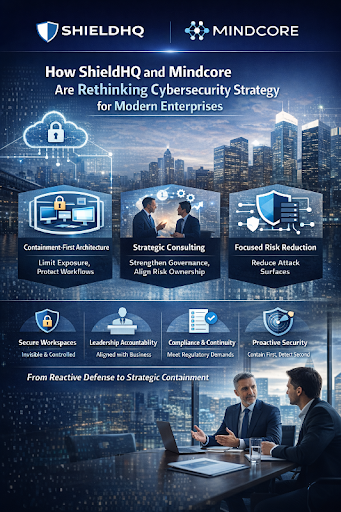
Cybersecurity has entered a new era. Traditional approaches focused on perimeter defenses, signature-based detection, and manual incident response no longer scale. Today’s organizations must adapt to hybrid workforces, cloud-native services, third-party integrations, and constantly evolving threat tactics. As this shift accelerates, enterprise leaders need security strategies that align with business continuity, governance, and risk ownership rather than just threat hunting.
Two concepts are helping organizations make that transition: secure workspace architectures and strategic cybersecurity consulting. At the intersection of these ideas is ShieldHQ , a solution designed to reduce exposure by confining high-risk workflows to protected environments, and Mindcore, a security-focused consultancy that helps businesses transform their cyber posture from reactive to proactive.
Why Traditional Security Models Fall Short
Most security models assume that visibility is necessary. Networks respond to scans. Endpoints connect. Users operate within known boundaries. Security tools then rely on detection, analytics, and human investigation to prevent or mitigate breaches.
In highly interconnected systems, however, visibility itself becomes a liability. Each access path, device, and remote session increases the attack surface. When systems are visible and reachable, threat actors can map, probe, and exploit vulnerabilities faster than many teams can detect and respond.
This dynamic places undue strain on security operations and leadership decision-making. Organizations may have the best tools, but without a strategy to contain exposure, even sophisticated toolsets leave risk behind.
Containment Versus Detection: A Strategic Shift
Secure workspace architecture reframes the problem. Instead of merely detecting threats within exposed environments, it limits the environments that can be exposed. Users access secure workspaces where the underlying infrastructure remains invisible to direct scanning or discovery.
This design has profound strategic implications:
- Risk is limited by design , not just monitored.
- Incidents are contained structurally , not just investigated reactively.
- Executive accountability becomes clearer , because outcomes reflect intentional architecture rather than tool proliferation.
ShieldHQ embodies this philosophy by providing protected environments that contain specific workflows rather than broad network segments. This containment approach reduces the potential blast radius of compromise while preserving productivity for legitimate users.
Bringing Enterprise Needs into Focus
For large enterprises, security is not purely a technical problem. It is a business problem that touches continuity, compliance, customer trust, reputation, and operational efficiency. Decision makers must balance:
- Risk reduction
- Regulatory obligations
- User experience
- Scalability
- Cost efficiency
- Executive accountability
This balance is the heart of Mindcore’s consulting philosophy. Rather than recommending one more tool, Mindcore works with organizations to understand how people, processes, and systems interact — and then aligns those elements with risk tolerance and business outcomes.
By integrating strategic consulting with architectural design, Mindcore enables leadership teams to prioritize systemic improvements over symptomatic fixes.
How ShieldHQ Reduces Exposure in Practice
At the core of ShieldHQ’s design is the concept of scope reduction . Instead of extending trust to network paths and broad infrastructures, access is scoped to specific workspaces that contain what users need without exposing what they do not.
This approach reduces attack surfaces in several ways:
- Infrastructure remains non-discoverable to unauthorized scanning.
- Lateral movement is constrained , limiting the potential impact of breaches.
- Credential exposure loses value because access does not automatically grant broader reach.
- Third-party and contractor risk is confined , even when remote access is required.
The result is a security posture where containment becomes the first line of defense, not a backup after detection.
Why This Matters for Regulated and High-Risk Industries
Industries such as healthcare, finance, and legal services operate under stringent compliance requirements. These sectors face dual pressures: protecting sensitive data and demonstrating that protection through evidence, not assumptions.
Secure workspace architectures support both demands:
- Containment provides verifiable boundaries , which are easier to demonstrate in audits.
- Design-driven control aligns with regulatory expectations , reducing the need for exception-based documentation.
- Operational continuity improves because incidents are less likely to cascade.
Mindcore’s consulting framework helps organizations map their compliance obligations to architectural protections, ensuring that strategic decisions reinforce both security and governance.
Leadership and Cybersecurity Accountability
Security outcomes increasingly fall into executive hands. When breaches occur, boards and CEOs are asked not only what happened but why the architecture allowed it.
Matt Rosenthal , a cybersecurity leader with extensive experience aligning security strategy with business priorities, emphasizes that architecture should reduce leadership exposure rather than amplify it. Systems that rely on constant reactive measures transfer risk to human operators. Systems that contain risk structurally transfer confidence to leadership.
This mindset shift from reactive monitoring to strategic containment is one of the most important developments in enterprise cybersecurity today.
Practical Steps for Organizations Today
If an organization wants to modernize its cybersecurity posture with strategic intent, the journey typically begins with three steps:
- Identify the most sensitive workflows — those whose compromise would cause the greatest harm.
- Constrain those workflows within secure workspaces or isolated environments.
- Align governance, compliance, and leadership accountability with architectural decisions that reduce exposure.
This approach helps organizations move from ad-hoc risk management to integrated risk reduction that supports both security and broader business goals.
Final Perspective
Cybersecurity is evolving beyond threats and tools. It’s now about architecture, accountability, and strategic design . Solutions like ShieldHQ show how secure workspace models can contain risk structurally, while consultative partners like Mindcore help tie those models back to enterprise priorities.
In a landscape where both threats and systems are accelerating, containment is not just a technical improvement. It is a strategic advantage.
